auditory plan
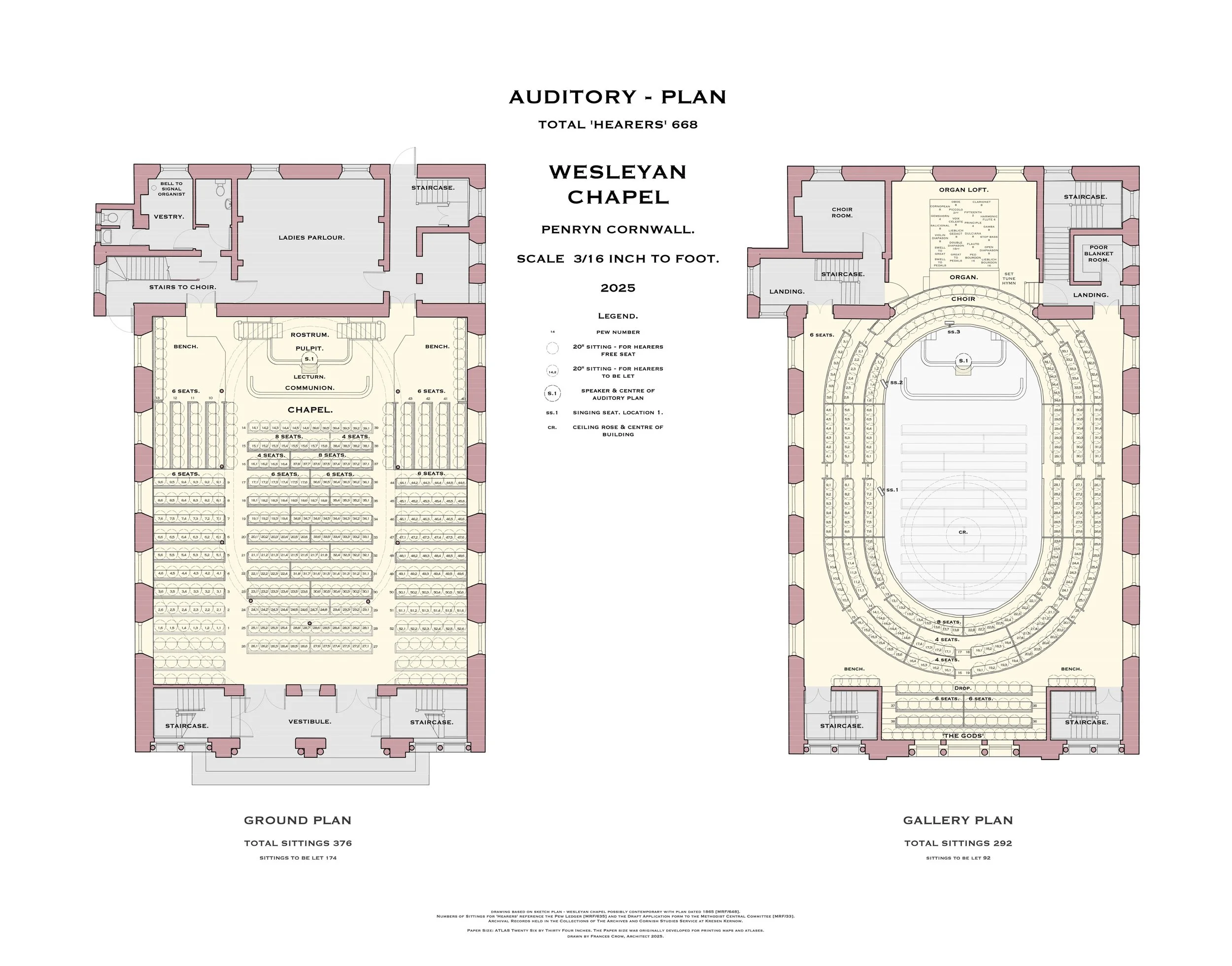
Auditory Plan
A fundamental principle in the design of Methodist Chapels is the Auditory Plan. In our Church Records project, we wanted to find evidence for the Auditory Plan in the building and the historic records of the Penryn Methodist Chapel.
The Auditory - Plan image is a re:drawing of the ‘Sketch - Plan of the Penryn Wesleyan Chapel’(1.) found in the archives at Kresen Kernow overlaid with sonic clues from the existing building and the 20” ‘sittings’ allocated for the ‘members’ and ‘hearers’ in the specification for the Chapel sent to the Central Methodist Committee for funding (2.).
From this drawing we can see the form of the chapel as it would have been at its opening service on 14 February 1893, and how that form was dictated by the Auditory Plan: that every member of the congregation should hear and see the preacher. (3.)
This Auditory-Plan is also the key to locating the recordings made as part of the Church Records project and documented in the Church Records Gazetteer. The numbering of the pews and the ‘sittings’ is taken from the pews themselves and reference the Pew Rent Ledger found in the Kresen Kernow archive. (4.)
The Church Records Archive is hosted by Art Centre Penryn. There you can access recordings made as part of Re:Sounding, an evening of music and song with Mabe Ladies choir, coordinated by Small Acts and featuring a short 'lecture' about the Auditory plan, delivered from the 'pulpit’.
Frances Crow 2025
‘Ground and First Floor Plan showing sittings’. Collections of the Archives and Cornish Studies Service as Kresen Kernow. Archival Reference: MRF/648
FORM OF APPLICATION TO THE WESLEYAN CHAPEL COMMITTEE FOR PERMISSION TO ERECT A CHAPEL Collections of the Archives and Cornish Studies Service as Kresen Kernow. Archival Reference: MRF/33
The Auditory Plan as described in Historic England (2019) Methodist and Nonconformist Chapels in Cornwall: Guidance and Assessment Framework. Appendix 1- An illustrated guide to the Historic Chapels of Cornwall. Swindon. Historic England. [pp.7]
The Historic England document draws heavily on research carried out by and documented in the brilliant book: Lake, J. Cox, J. Berry, E. ‘Diversity and Vitality: The Methodist and Nonconformist Chapels of Cornwall’Cornwall Archeological Unit, 2001 [page
The Chapel celebrated the opening of the building on 14 February 1893 without its Organ, which was installed a year later in 1894.